You have a hobby of creating handmade products, very well. And now you want to monetise your hobby, excellent! But the journey from this realisation to actually making it happen is a distant one. But, the good news is that it can be done, with the right tools and strategies.
Yes, starting a successful handmade business online might be difficult but not impossible. In fact now is actually the best time to start an online business of your own(all the more for handmade businesses), be it full time or a side hustle. Let’s leave this discussion for another time, and focus on the current topic at hand.
Question: How to start a successful handmade business online?
Answer: With the right recipe and good ingredients.
Yes, there is always that perfect recipe that you can never go wrong with, the recipe you can always trust to turn out perfect when followed to the T. It’s just about discovering THAT PERFECT RECIPE.
It’s the same with starting a successful handmade business online. And we have discovered that perfect recipe, that we have applied to several of our clients’ handmade businesses and made them successful.
Before we get into the recipe, we have to disclose the Ingredients that make up the recipe. So here they go:
- Mindset of a business owner rather than a hobbyist
- Commitment and perseverance to work towards your dream
- Patience to nurture your business and watch it grow
It is very important to get these things right first and then move on to the recipe, else a recipe without the right ingredients is a surest recipe for failure!
So, Are you ready for the big reveal of the recipe? Here we go:
Step 1: Set your goals
This is the most important step before you begin your journey.
Unless you know what you want to achieve, how would you know if you are successful.
What is it that you want to achieve in terms of say your revenue, your social media standing, your team size, etc. Set goals for yourself for the next 1 year, 2 years and 5 years. Breakdown the yearly goals into quarterly or monthly milestones. Once you have this in front of you , you will realise that it becomes a tad bit easier for you to know what tasks you’ve got to do and when.
After you have formed your goals, don’t just sit on them. What is important is that you review the milestones and recalibrate your tasks and/or goals after comparing your plan vs actuals. This is just as important as forming your goals, else your goal sheet will remain just an exercise.
Step 2: Know your Market
The most asked question that we get is:
Where do we even begin???
Researching the market is usually the best place to start with. It is important to know how big the market is, what kind of products are selling and at what price. Here are a few things that you MUST research before diving onto starting your business:
- Are people buying the products that you are planning to sell?
- What terms are buyers searching with?
- What are the competitors selling and at what price?
- What is the economic viability of selling your product at a competitive price?
- What is the seasonality of the product?
These are some of the most important questions that you must answer in order to take a logical decision about starting your decision and not regret later about starting a not so profitable business.
Step 3: Know your customer
Now there’s this big debate of whether you should be a Specialist or a Generalist. A lot of people can say a lot of things, but our experience says it is always easier when you solve a specific problem or problems of a specific group of people and get known for that.
We swear by this mantra:
When you create for everybody, you create for nobody.
Your products can’t suit everybody. When you try to create products for everybody, you will not be able to delight any of your buyers and end up having a lot of dissatisfied buyers. Rather, choose a specific group of buyers and create products that solve problems for only those buyers, also called niche market. This way you will have less unhappy customers.
Now coming to customers, once you have identified your niche market, it’s critical to get to know your niche market like the back of your hand. An ideal customer for any business is someone who will:
- Happily pay for what you offer
- Appreciate what you do for them
- Easy to communicate with
- Keep coming back
- Recommend you to others
So the next critical task is going to be to identify our ideal customer. Answer these questions about your niche market:
- What is the demographics of your ideal customer?- Age, gender, location, language, education, job, relationship status, etc.
- What are the psychographics of your ideal customer?- Beliefs, values, lingo, habits etc.
- What problems are they facing that your product is going to solve for them? – Look beautiful, save time, social validations, etc.
- How do they spend their day?- schedule, digital behaviour, etc
- What blogs, celebrities, brands, influencers, pages do they follow on social media?
Create an ideal customer workbook for easy reference. This workbook might have multiple versions as you keep learning in your business, but this document is going to be handy for you from time to time. We have an ideal customer workbook in our resource library, you can get a free access to the same by clicking here.
It is always difficult to identify that one customer. But once you have identified that one ideal customer, it is easier to look for more like them.
Step 4: Build your brand
A brand is a name, term, design, symbol, or any other feature that identifies one seller’s good or service as distinct from those of other sellers.
– American Marketing Association
Your brand is what will differentiate you from your competitors and enable you to charge the price that you want from your buyers. Create a brand that speaks the same language as your ideal customer. Start by creating the following:
- Business’ mission, vision, values
- Brand style guide
- Logo
- Visual elements like colour palette, font, images
- Brand tone
- Website copy and aesthetics
- Social media aesthetics
- Tone of communication
You can get in touch with us if you need help with branding your business.
Step 5: Build your business foundations
If you have followed steps 1-4 you have the frame of your business ready. It’s now time to fill it up with all things good. At this stage, you need to take some critical decisions about your business and here they are:
- Pricing: What is going to be the selling price of your product? What is going to be your profit margin? And most importantly, how much are you going to pay yourself for creating the products?
- Business Model: Where are you going to sell- your own website, Etsy, Amazon? What collection are you going to sell first?
- Product Photography: How are you going to photograph your products? Do you have the requisite skills and props to do so? What is going to be your photograph aesthetics?
- Logistics: How are you going to ship your products? How is it going to cost you? Will you charge extra for shipping?
- Packaging: How are you going to package your products so that they reach your customers without any damage? How are you going to source your packaging? How can you personalise your packaging so that it is inline with your branding? How can you optimise your packaging so that you don’t have to pay more for shipping it?
- Payment: How are you going to accept payment? Do you have the documents ready for accepting payment? Do you need to register your business to accept digital payments?
Step 6: Create a marketing Plan
Now that you have the business structure ready, it is time to figure out how you are going to market your products. In today’s world, only a good product that also is marketed well will sell. Sad but true, however good your products are, if you do not have a strong 360 degree marketing plan, your products are not going to sell.
So decide on the below points to create a marketing strategy for your business:
- What social media channels are you going to be present on?- Facebook, Instagram, Pinterest, maybe? It is important to be present on just a few social media channels to begin with, and mastering them before getting onto others.
- Content Strategy: Create a content strategy that encompasses every stage of a buyers journey. Don’t just be pushy for sales. Create and give value, your sales will eventually happen.
- Email List: Build an email list, this is the only thing that is not affected by any algorithm changes of any social media channels.
- Analytics: Decide on the KPIs that matter for you business and track them.
Step 7: Promote your business
It’s time to spread the word! Go about executing your marketing plan.
Social media can be overwhelming, but to avoid the burnout you can create a social media calendar in advance and schedule your posts in advance. Stick to your brand aesthetics, post good pictures, provide value and engage with your audience.
Write to your customers on email and stay in touch with them.
Spend some money in running ads, set up a funnel and retarget customers who have shown interest in your products.
If you do this religiously, you will sell out sooner than you know!
Step 8: Delight your customers
What do you do after you have got that sale? The customer journey doesn’t end there, there are a few very important steps to be taken:
- Fulfill the order timely and safely
- Acknowledge your buyer for the sale and update tracking information
- Request your customers to leave a feedback on your social media handles or website
- Attend to any negative feedback and see if there’s something you can do about it. Learn from your mistake.
- Encourage your customer to repeat purchase from you
These are all a part of customer servicing and go a long way in delighting your buyer. Happy buyers come back to you again and bring few more with them.
It is always cheaper to get repeat business form existing customers than getting new customers every time.
Step 9: Reinvest in your business
With a great marketing plan and a few tools, you can make your business work for you in an automated fashion, rather than you slogging to build your business. Once you make a few sales, reinvest the money back in your business. Here are a few great reinvestment avenues that are going to pay you back in multiples:
- Social media ads
- A great website
- An email tool
- SEO and google ads
- Influencer marketing
Step 10: Manage your finances
Some business owners get so overwhelmed with the process so far that they forget about their finances. Don’t forget that the primary objective of any business is to make profit. And to do that you need to reconcile your finances.
Making sales is not equivalent to making profit. As a business owner, you need to know your numbers. Know how many sales you need to make and at what price to break even your business. Chances are that you might not be able to break even in the first few months, but that’s okay. What is important is that you break even at least within 3-6 months and multiply your profits many fold in the next months to make up for the losses.
Have a robust invoicing system and keep a track of the below items:
- Income and expenses
- Taxes and Accounting
- Compliance with laws
If you think you are not good at it, it’s best not to mess around and hire a professional for the same.
So, this was the exact blueprint we follow with our clients to help them start a successful handmade business online. We can teach you how to implement this blueprint with exact actionable steps, tools and strategies for success and some exciting bonuses inside our course Handmade Business Owners Academy- Start a successful handmade business online.
Still not convinced about taking the course, that’s okay! We might still be able to help you…
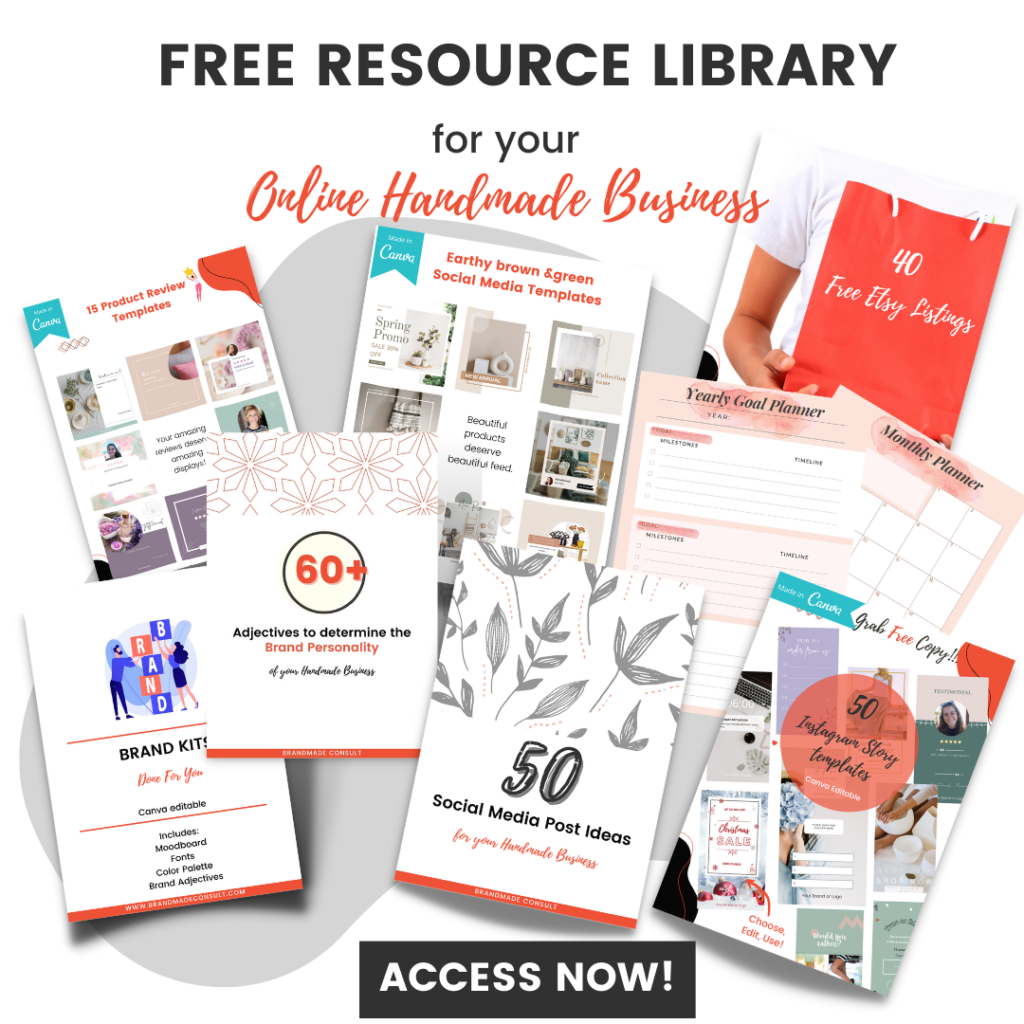
We have curated a resource library specially for handmade business owners like you. Access multiple templates, cheatsheets, workbooks etc for free by clicking here.